
Frequently asked questions
Direct answers about Spala.
What the platform does, how agents connect, what can be exported, which assurances are not claimed, and how to evaluate the product with real evidence.
What Spala is built to do.
Spala is most useful when an app or prototype needs a backend that both people and coding agents can inspect before it is published.
What is Spala?
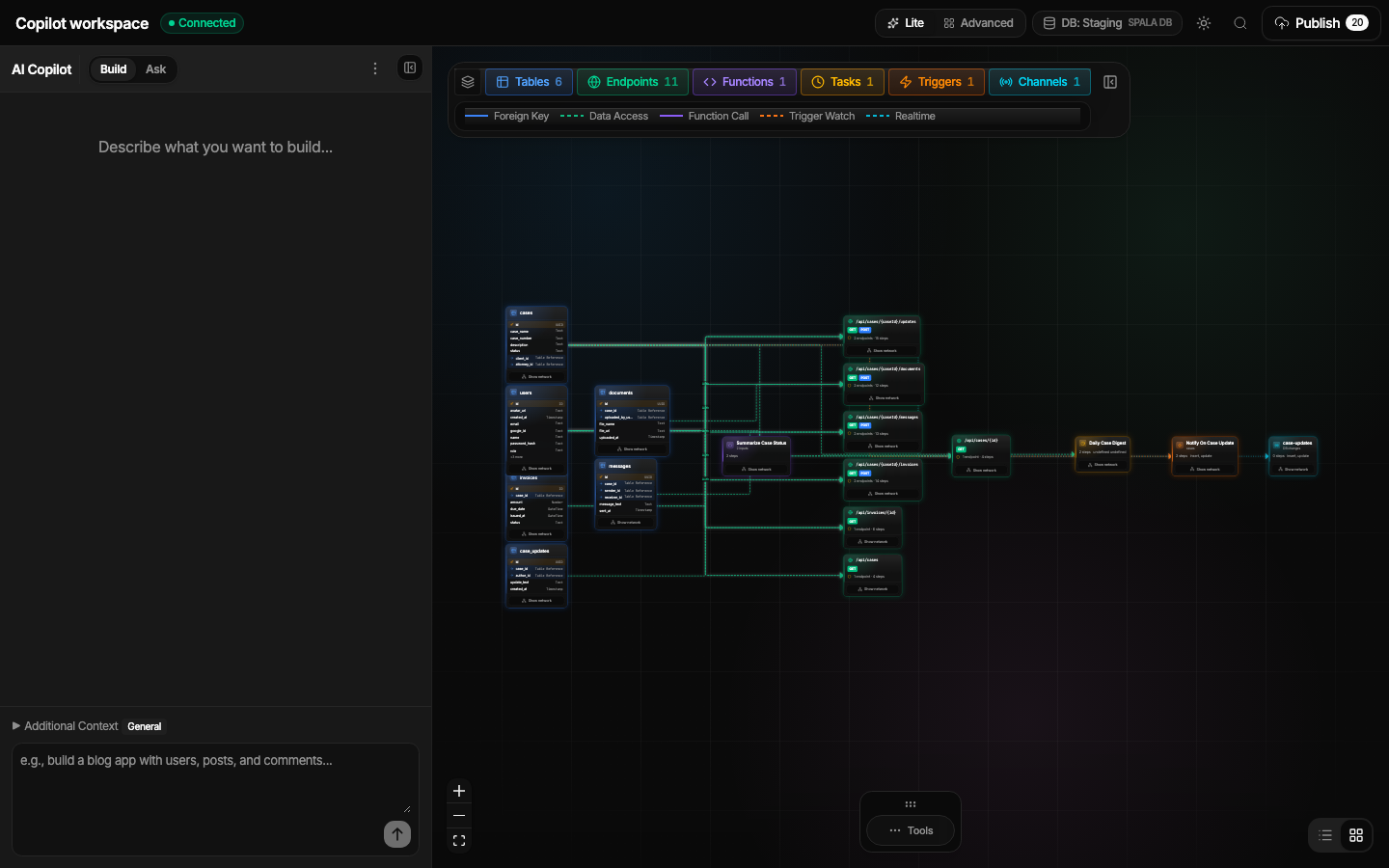
Spala is a hosted backend control layer for AI-built apps. It helps teams create and inspect PostgreSQL data models, authentication, REST APIs, backend workflows, validation, documentation, publishing, frontend handoff, and project-scoped MCP access.
Who should try Spala?
Founders, frontend developers, agencies, and AI coding-agent users who have an app idea, generated frontend, or prototype but need a visible backend contract. Start with a small representative workflow before adopting it for a whole product.
Does Spala build the frontend too?
Spala is primarily the backend and handoff layer. A project can stage and serve a validated static frontend package, but Spala is not a replacement for a full frontend design system or application framework. React, Next.js, mobile, Webflow, and other frontends can consume the published API.
Is AI generation production-ready without review?
No. Hosted generation includes planning, generation, validation, repair, and publish gates, but complex one-prompt production generation is not currently proven reliable. Inspect the schema, routes, access rules, workflow steps, and errors; then test the actual project before launch.
How Spala works with coding agents.
Public MCP explains the product. Project MCP works on an authorized project. Keeping those surfaces distinct is part of the security model.
How does Spala MCP work?
Connect to https://mcp.spala.ai/mcp for public product discovery, onboarding, docs, templates, and addon information. For real project work, use the exact authorized project MCP configuration supplied through Spala. Project MCP can inspect, change, validate, publish, and review a selected project within its granted scopes.
Can public MCP create or modify my project?
Not through an anonymous public flow. Public project listing and handoff currently fail closed. Public discovery and dry-run responses do not create, select, or change a hosted project.
What does frontend handoff include?
Spala can generate JSON and Markdown API documentation, OpenAPI, JavaScript and TypeScript SDK output, declarations, and request snippets. The handoff should also record the exact API base URL, auth behavior, CORS origin, errors, upload or realtime contracts, and publish state. Generated docs alone do not prove live behavior.
What to verify before production.
The platform implements real controls and exports. Contractual assurances and application-specific correctness still need explicit evidence.
Can I export my project and data?
Spala supports project, JSON and CSV data, and packaged runtime ZIP exports. Spala itself is not open source, and export capability is not a promise of an effortless migration to every other platform. Confirm exactly what is included and the applicable deployment or license terms.
Is Spala security or compliance certified?
Spala implements authentication, authorization semantics, static project and SQL analysis, publish integrity checks, and sandbox validation. It does not currently make public SOC 2, ISO 27001, HIPAA, independent penetration-test, or blanket production-security claims. High-risk projects need project-specific tests and, where appropriate, independent review.
Does Spala publish an SLA or uptime history?
No public formal SLA, historical uptime platform, or incident archive is currently proven. The reliability page and status JSON are evaluation aids. Confirm account-specific uptime, monitoring, support, backup, restore, and incident terms directly.
Are project snapshots complete backups?
No. Project snapshots exclude database rows, uploaded files, environment secrets, database configuration, runtime artifacts, and encryption keys. Production recovery needs separate backups and a rehearsed restore process.
Where can I see current pricing?
Use the public pricing page for current offers and starting prices. Confirm exact scope, renewal, cancellation, support, taxes, overages, and managed-build deliverables in the applicable proposal or agreement.
How should I start?
Create a low-risk project, build one auth-aware workflow, inspect all generated resources, test success and denial paths in API Playground, publish only reviewed changes, and verify the frontend handoff. The start guide gives the full sequence.
Still deciding whether Spala fits?
See the current product screens, compare the workflow with other platforms, or ask about your specific backend.